
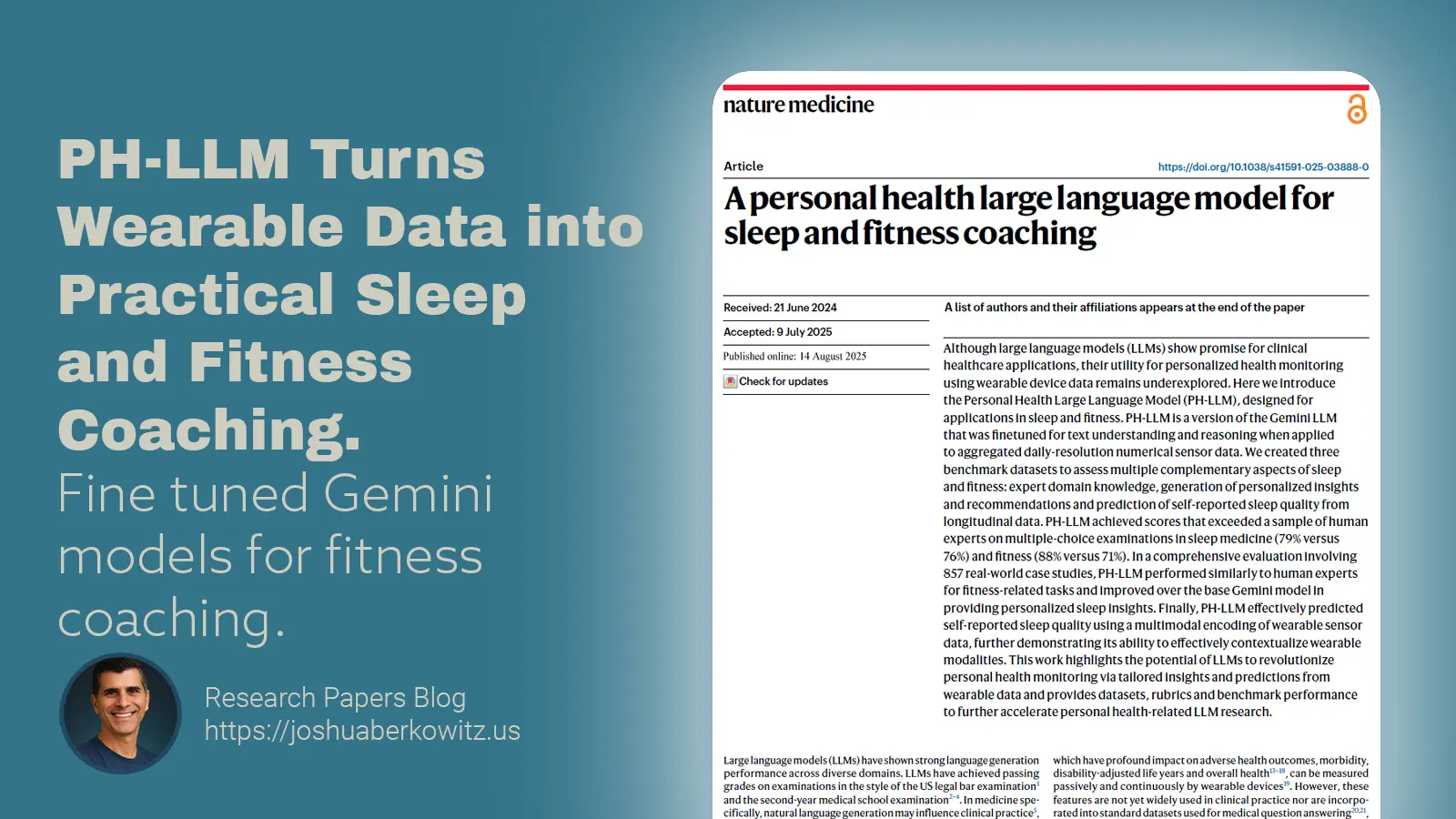
Personal Health Large Language Model: The rise of large language models (LLMs) has transformed industries ranging from law to education, and healthcare is now at the forefront of this revolution. While LLMs like GPT and Gemini have already demonstrated impressive performance in clinical question answering, diagnosis assistance, and psychological support, their potential in personalized health monitoring remains underexplored. This is especially true in domains such as sleep and fitness, where wearable devices capture vast amounts of continuous data that often go underutilized in clinical practice.
What is PH-LLM?
PH-LLM (Personal Health Large Language Model) is a specialized version of the Gemini Ultra 1.0 model. It is finetuned on sleep and fitness case studies with aggregated daily wearable data, demographic information, and exercise logs. Unlike general-purpose models, PH-LLM is explicitly designed to:
- Understand and contextualize numerical sensor data
- Provide personalized coaching recommendations
- Predict subjective health outcomes, such as self-reported sleep quality
Contributions of PH-LLM
1. Expert-Level Knowledge in Sleep and Fitness
PH-LLM was evaluated using multiple-choice examinations modeled after the American Board of Internal Medicine (ABIM) Sleep Medicine exam and the National Strength and Conditioning Association (NSCA) fitness exam. Results showed:
- 79% accuracy in sleep medicine (higher than 76% average of human experts)
- 88% accuracy in fitness (well above the 71% expert benchmark)
2. Personalized Insights and Coaching
The model was tested on 857 real-world case studies, where it generated long-form, personalized recommendations. Using a custom evaluation rubric, PH-LLM demonstrated:
- Strong ability to incorporate user data
- Contextualized advice tailored to lifestyle patterns
- High readability with minimal confabulations
3. Predicting Sleep Quality from Wearable Data
PH-LLM introduced a multimodal adapter for predicting patient-reported sleep quality. By analyzing 15+ days of longitudinal wearable data, the model could anticipate subjective sleep disruptions, helping users proactively adjust behaviors.
Read about : Mental Health of Adolescents: Key Facts, Challenges, and Global Response
Why PH-LLM is a Breakthrough
Integration of Wearable Data
Unlike conventional LLMs, PH-LLM effectively interprets raw wearable metrics—from daily activity levels to sleep cycles—transforming them into meaningful, actionable feedback.
Continuous Personalized Coaching
Instead of static reports, PH-LLM acts as a dynamic coach, continuously updating its recommendations based on incoming data.
Safe and Reliable Guidance
PH-LLM was evaluated for safety, personalization, and evidence-based reasoning. Its results demonstrate minimal risk of harmful recommendations while maintaining expert-level accuracy.
Extensibility Beyond Sleep and Fitness
Although focused on sleep and fitness, the framework and datasets created for PH-LLM are extensible to other domains like stress management, cardiovascular health, and nutrition.
Also read: Ather Redux Moto-Scooter Concept Unveiled – A Blend of Scooter and Sportbike
FAQs
1. What makes PH-LLM different from general-purpose LLMs like GPT or Gemini?
PH-LLM is fine-tuned specifically for sleep and fitness coaching. While general models can answer health-related questions, they often lack the ability to interpret sensor data from wearables.
2. How does PH-LLM use wearable data for health insights?
The model processes aggregated data from wearable devices, including daily sleep patterns, activity levels, and exercise logs.
3. Is PH-LLM a replacement for doctors or clinical visits?
No. PH-LLM is designed as a supplementary tool, not a replacement for clinical care. It provides lifestyle coaching and insights, while medical diagnosis and treatment remain the responsibility of healthcare professionals.
4. How accurate is PH-LLM compared to human experts?
In evaluations, PH-LLM outperformed human experts in multiple-choice examinations for sleep and fitness. It also performed on par with experts in real-world case studies, demonstrating its reliability in providing safe, evidence-based recommendations.
5. What are the future applications of PH-LLM beyond sleep and fitness?
The underlying methodology of PH-LLM can be extended to other domains like stress management, cardiovascular monitoring, nutrition, and chronic disease prevention.